I have a lot of games on Steam, far more than my puny hard drive can hold at once. However, in the future I may want to store all of them locally.
Is there any way to figure out about how much hard drive space I'll need to install all of my Steam games, including the ones that I don't currently have installed, without sitting down with a calculator and manually adding everything up?
27 Answers
Not to bump an old thread unnecessarily, but I just finished building the tool I think you're looking for:
Your profile has to be public and it's not perfect, but should give you a pretty close idea of what kind of hard drive space you'll need to install your entire collection (or on multiple drives, per Steam's new feature to specify install location).
Cheers!
[Edit] Just realized a screencap might be nice:
Short answer
Go to this jsFiddle, bookmark the link (it's a bookmarklet), go log in to Steam on your browser, look at Community -> Games -> All Games, use the bookmarklet (open it like you would a bookmark). You'll get an alert telling you the size on disk and the size you'd need to buy, approximately.
Longer answer
It turns out that when you visit the All Games page on your user profile, Steam stores information on them in a Javascript variable embedded in that page named rgGames. After a bit of messing around, I created a bookmarklet that will inspect that variable, sum up all the file sizes, and tell you the total size in both real and marketing terms.
The one caution I would have is that bookmarklets are a pretty insecure thing to use, so I strongly urge that you only do this if either you can understand Javascript well enough to know that my script is not doing anything sneaky, or you trust me. muahahaha A bookmarklet can do almost anything you can do on a website as a logged in user, so I could, I don't know, make all your games start installing on your computer or something (ssl should block the script so I don't think anything super important is vulnerable).
That being said, here's how you use it:
1. Go to this jsFiddle, right click the link, click "Bookmark this link" or whatever equivalent your browser has. 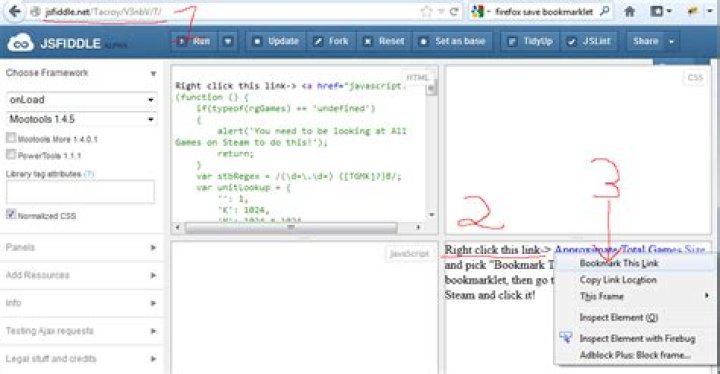
2. Go to Steam, make sure you're logged in to your account, then go to Community -> Games -> All Games. Make sure you're looking at your profile, unfortunately you can't use this to calculate the total size of any of your friends' libraries. Once you're at the All Games page, click the bookmarklet in your bookmarks, and it'll do its thing. 
3. You'll get a popup kinda like this. The difference between "real" gigabytes and "marketing" gigabytes is a boring, complicated mess that nobody cares about and thankfully is going away with SSDs - just know that the "marketing" size is the amount of space you'd buy, the "real" size is the size you'll see on your computer if you install everything. 
Now, there are a couple of caveats: this isn't using any official Steam feature, so the method may very well stop working at any point without warning. Another problem is that at least one game is messed up on this page; see where it says that Trine 2 takes up 13.7 MB of space? That's filthy lies. The game takes up about 1.5 GB of space.
All that being said, however, this should give you a reasonable idea of how much space you'd need to store your entire Steam library on a disk. Just go up a couple of steps (plus however much more you want to store the rest of the kipple we all carry around everywhere between hard drives), and you should be good.
3I've been thinking about this off and on today, and while I don't have an answer, I have an idea for how the answer could be done. Borrowing from xkeeper's answer, I imagine an application that can scrape data from the "System Requirements" page at the bottom of each game's store page and crawl through all a user's games could knock this out and even provide a range between "minimum" and "recommended."
Now someone just needs to write it :)
Okay, the bookmark applet didn't work for me, but I have a slightly less simple but more reliable way to do it.
You'll need an open text file to write down some numbers. For bonus points, you can fire up an Excel file to auto-add everything for you.
So first you need to figure out exactly how big all your currently installed games are. (Don't worry, we're gonna count your entire library, but you need to do this part separately.) Just right click your steam folder and select properties (or steam apps if you want a slightly more accurate footprint.) If you have multiple steam install locations, you need to do this same thing for all of those too.
Write down the result. lets say its STeam folder: 100gb.
Now go into your steam library via steam. Select ALL your games. All of them. Even the installed ones. Just grab everything. Now right click one of them and select "Install selected." Steam will show you how large the install size is! Write this down too. For our example lets say it's 3000gb.
Okay, so here's the thing, even though you selected your already installed games, Steam did not count them in the files to be installed size. So you want to add your currently installed games (100gb) to your install games result (3000) gb to give you your total steam library size: (3100gb)!
Done.
1Quick and dirty way, for games you already installed:
- Browse to your Steam folder (usually \Program Files\Steam)
- Select the "steamapps" folder
- Right click it and select "Properties"
- Wait a while for the total size to be calculated
This may not be entirely reliable if there's a game out there that doesn't play nice with Steam (and installs to an external folder...) but I haven't really ran into one, yet. For the most part it'll give you a good enough idea.
But...
If you're trying to do this for games you haven't installed, you're kind of out of luck, I've found. Outside of adding them up manually, you don't have many options. Sorry. (It doesn't help that some games may have varying sizes depending on what DLC you have, the kind of computer you're running, and whether Steam will have to install additional things to run the game, e.g. DirectX runtimes)
1None of the answers will work fully.. I don't know why but for example ARK Survival which takes over 70 GB says on the product page 40000 MB AND when trying out those javascripts or steamgauge site it reports 0 Byte...
So in the end there needs to be a better tool/site.
Three options come to my mind.
Let a tool search through the shopsites, as already said by Dave McClelland.
Someone could however collect the sizes from users who have the game(s) installed and publish them on the site.
Collect sizes too but this time only from the install dialog of steam .
To the first I have to say again it is not accurate as the ARK install was above that in the end.
Second one would take some time and may have wrong data mixed in because of mods.
For the third I don't know if it can be automized too but it seems to be the most accurate of all.
In the 10 hours that has passed since you've asked this question, you could have done it manually (now keep in mind, I'm not criticizing you, I'm just using this to point out that doing it manually might be the only way). For all the games that are installed, right click them in the Library menu, and click Local Files. It will tell you how much disk space is being used by that game. For those you don't have installed, just click on them, and click the Install button. Take Disk space required and cancel out of it. Write down all the values on a piece of paper and add them up with a calculator (or even better, write them down in a notepad program separating each one by an addition sign, and then enter it into Google and it should do it for you. You could also do it in Microsoft Excel, which would be good if you wanted to continuously update it).
Edit: For the adding-it-up-in-Google option, that will only work if you have less than 32 games... (because Google won't let you search more than 32 words).
6